Dune Houses Explained: Atreides, Harkonnen & Corrino
Meet the three central Dune Houses, trace Paul’s family tree, and see how marriage, the Emperor and the spice trade connect them.
Bookis Editorial11 min read
Contents
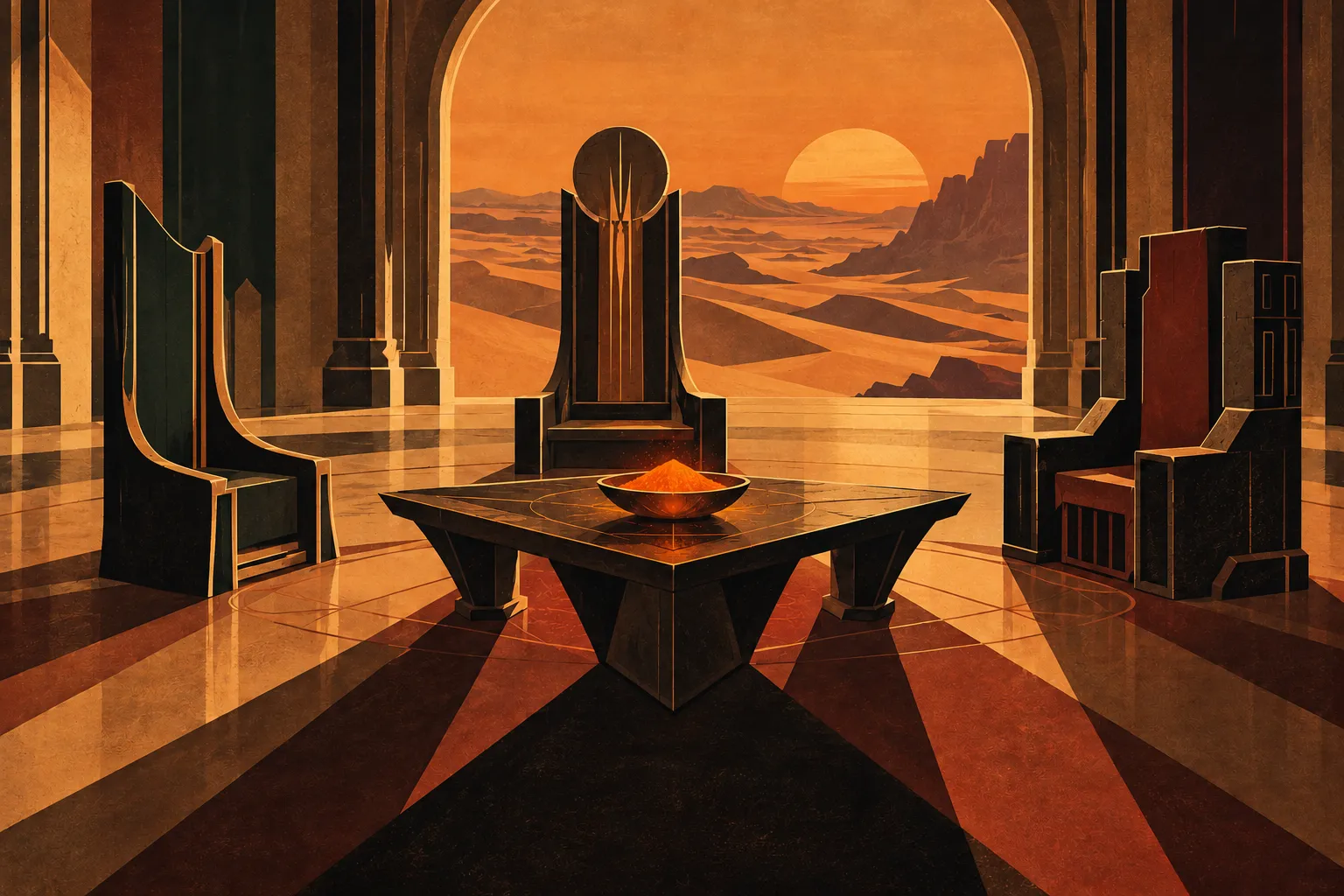
The Great Houses in Dune are aristocratic dynasties that govern worlds, command troops and hold commercial interests. Three families drive the opening struggle: House Atreides, led by Duke Leto; House Harkonnen, led by Baron Vladimir Harkonnen; and House Corrino, the dynasty of Emperor Shaddam IV. Their contest over Arrakis connects a family feud to the supply of spice on which the Imperium depends.
A daughter can belong by birth to one House and build her life in another. A marriage can settle a struggle for the throne while a different woman is the mother of the ruler’s children. The names become easier to follow once those connections have labels.
Spoilers: the family map reveals relationships and events through Children of Dune. The political and harvesting maps describe the beginning of the first novel; a later change in spice production is identified separately.
The three central Dune Houses at a glance
| House | Leading figure at the start | Home or seat of power | Political strength |
|---|---|---|---|
| Atreides | Duke Leto Atreides | Caladan; then assigned Arrakis | Loyalty, trained troops and standing among the Great Houses |
| Harkonnen | Baron Vladimir Harkonnen | Giedi Prime; outgoing rulers of Arrakis | Spice wealth, coercion and calculated alliances |
| Corrino | Emperor Shaddam IV | Imperial court on Kaitain | The throne and the Sardaukar |
These three families stand at the centre of this guide, but they represent only the pinnacle of a vast feudal order. Hundreds of other Great Houses form the Landsraad, the council of the galactic aristocracy.
Individually, no single family can withstand the Emperor’s legions of Sardaukar. Together, however, the combined fleets and atomic arsenals of the Great Houses hold enough force to overwhelm the throne itself. The Landsraad operates as an engine of collective security: if an Emperor should openly destroy one noble House, the others would unite against him in self-defence. That delicate balance explains why Shaddam IV cannot simply strike at Duke Leto in the open, forcing him instead to disguise his support behind a Harkonnen assault.
Paul Atreides’ family tree
The Baron is uncle to these two brothers
Baron Vladimir Harkonnen ↓ father of Jessica
Partners: Jessica is Leto’s concubine, not his wife.
↓ their children
↓ Paul and Chani’s children
House Corrino and the dynastic marriage
father of
dynastic marriage
Paul → Jessica → Baron Vladimir Harkonnen
Paul is Jessica's son, and Jessica is the Baron's daughter. The Baron is Paul's maternal grandfather.
Follow the Houses, worlds and unfamiliar terms further in our illustrated companion, DUNE Lexicon & Lore.
Are the Atreides and Harkonnens related?
Yes. Lady Jessica is Baron Vladimir Harkonnen’s daughter and Duke Leto Atreides’ partner. Their children, Paul and Alia, are therefore the Baron’s grandchildren. Jessica is the Duke’s concubine rather than his official wife, and her Bene Gesserit training brings obligations beyond either household. Birth, education and personal loyalties meet in one person.
Who are Paul Atreides’ children?
Paul and his beloved Chani have a first son, Leto, and later the twins Leto II and Ghanima. Paul marries Princess Irulan of House Corrino in a dynastic settlement, but she is not their mother. That distinction matters to the people in the story as much as it does to the succession.
Three different Letos
| Name | Place in the family |
|---|---|
| Duke Leto Atreides | Father of Paul and Alia |
| Leto, Paul and Chani’s first son | Killed during a Sardaukar raid |
| Leto II | Their later son, twin of Ghanima and the future God Emperor |
The repeated name carries a family memory. It can also lead a reader to join two quite different lives by mistake. The first child does not grow up to become Leto II.

House Atreides: loyalty under pressure
The Atreides begin on Caladan. Duke Leto cultivates loyalty and a reputation for honour, while Gurney Halleck and Duncan Idaho help give his soldiers their strength. His political standing matters as much as the troops themselves: a respected Duke can become a focus for other Houses’ hopes and fears.
The order to take over Arrakis looks like an extraordinary promotion. It puts Leto in charge of the source of spice, replacing the Harkonnens. It also places his family inside a dangerous arrangement made by powerful rivals. The opening of the novel is wonderfully economical: the reward and the trap arrive in the same imperial instruction.
House Atreides is compelling precisely because its honour functions as a deliberate political strategy. Duke Leto understands that fear breeds quiet rebellion, whereas genuine trust binds people more securely than any contract. The strength of the House does not rest on slogans of virtue, but on actions that earn the unshakeable loyalty of those who follow it into battle.
House Harkonnen: Rabban, Feyd-Rautha and the succession
The Baron’s power rests on accumulated wealth, fear and the willingness to use people. His House rules from Giedi Prime and has extracted enormous profits from Arrakis. Losing the formal appointment to govern the planet does not end its interest in what lies beneath the sand.
The Baron plays a calculated double game, employing his nephews for opposing purposes. His nephews Glossu Rabban and Feyd-Rautha are brothers, not his sons. The brutal Rabban, known as ‘the Beast’, serves as a battering ram for the dirtiest work: squeezing Arrakis for every drop of spice at any cost, driving the population to exhaustion and drawing all their hatred onto himself.
The Baron’s design is cold and cynical. Once the planet reaches boiling point, he intends to cast Rabban aside and present the young, charismatic Feyd-Rautha as a welcome deliverer. Rabban is the scapegoat destined to absorb the people’s fury; Feyd is the polished facade and the intended future of the House.
| Connection | What it means |
|---|---|
| Baron to Rabban and Feyd-Rautha | Uncle to nephews |
| Rabban to Feyd-Rautha | Brothers |
| Baron to Feyd-Rautha | Ruler to chosen heir |
House Corrino: the throne needs a balance
Shaddam IV occupies the Imperial throne of House Corrino. The Sardaukar give his dynasty formidable military force, while the court on Kaitain provides the setting for its diplomacy. Its concern is the preservation of power in a system whose other participants can still make trouble.
Why does the Emperor oppose House Atreides?
Leto’s popularity among the Great Houses threatens Shaddam’s position. Military strength adds to that concern: Hawat explains that the soldiers trained by Gurney Halleck and Duncan Idaho could challenge the Sardaukar’s advantage if the Atreides could expand their force.
Shaddam secretly supports the Harkonnen attack on the Atreides with Sardaukar disguised as Harkonnen troops. An open imperial assault on a respected House risks bringing the Landsraad together against the throne. The old feud offers cover for the Emperor’s intervention, while the Baron sees a chance to destroy his rival and recover Arrakis.
That is the trap inside Leto’s promotion. The Atreides receive the source of spice wealth, the Harkonnens prepare to take it back, and the Emperor helps make the attack possible while concealing his part in it.
Emperor, Landsraad and Guild: who can carry out an order?
| Power | Its leverage | Its constraint |
|---|---|---|
| Emperor | Throne, Corrino dynasty and Sardaukar | Great Houses can combine against him |
| Landsraad | The Houses’ forces and alliances | Members have competing interests |
| Spacing Guild | Monopoly on interstellar transport | Navigators depend on spice |
An army still needs passage between worlds. Trade needs transport too. The Guild’s position reaches into both the Emperor’s plans and the Houses’ wealth, which explains why authority cannot be read from a family tree alone.
CHOAM is the commercial combine through which much of the Imperium’s trade passes. Shares, contracts and directorships turn commercial profit into influence. Spice is a great source of that profit, but the company also trades in other goods. Follow a shipment, and the interests of a House, a commercial combine and a transport monopoly begin to overlap.
Why spice makes Arrakis matter to every House
Melange from Arrakis
Navigation
- Guild Navigators use spice
- Limited prescience helps find safe routes
- Transport carries people, trade and armies
Life and dependence
- Consumers use spice for longevity
- Full addiction creates bodily dependence
- Withdrawal becomes fatal
Commercial influence
- Spice is traded
- Revenue feeds contracts and CHOAM interests
- Wealth supports political influence
The supply system at the beginning of Dune.
At the beginning of Dune, Arrakis is the only known source of melange. Guild Navigators depend on it for the limited prescience that helps them find safe routes. Spice is not the fuel in a ship’s engine. Its importance lies in the Navigator’s abilities and in the dependence built around them.
Spice also extends life and creates addiction. Withdrawal is fatal for someone fully dependent on it. Supply therefore connects the bodily needs of consumers to transport, commercial profit and the movement of armies. Ruling Arrakis brings immense leverage, along with the attention of everyone who cannot afford an interruption.
Arrakis’s monopoly on melange appears absolute, but it is not eternal. Thousands of years later, the Imperium will finally break its dependence on the desert world by learning to produce artificial spice, overturning the ancient balance of power forever. Who achieves that breakthrough, through what discoveries, and at what devastating cost remains one of the most compelling mysteries of Frank Herbert’s later novels.
From desert ecology to a harvest worth saving

The worm ecology of Arrakis
Formation
- Worm life cycle and early forms
- Underground pre-spice mass
- A spice blow exposes it to sun and air
- Melange forms at the surface
Collection
- Spice-bearing sand
- Harvester gathers the sand
- Machine separates melange
Evacuation
- Spotters and probes watch for worms
- Carryall lifts the harvester
- If that fails, other aircraft may rescue the crew
The harvester collects and separates spice. It does not manufacture it.
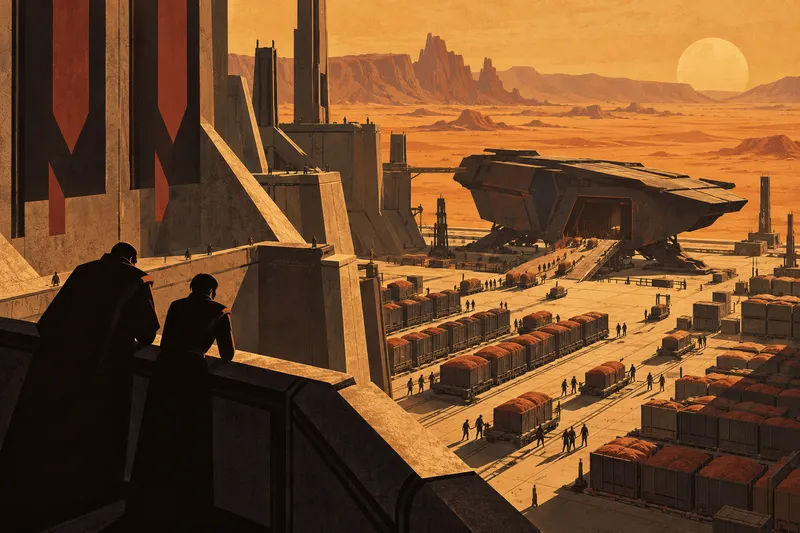
The worm ecology produces the conditions for spice formation; the harvester’s job is to collect spice-bearing sand and separate the melange. Around the machine, ornithopter spotters and seismic probes help detect an approaching worm.
The difference between lifting the harvester and rescuing its crew gives these scenes their urgency. If the carryall fails to arrive, other aircraft may save the people while the machine and cargo are lost. The same patch of sand holds workers’ lives, expensive equipment and the substance that keeps the wider economy moving.
A House, an order and a people are different kinds of connection
| Name | What it describes | Why the distinction matters |
|---|---|---|
| Mentat | A person trained in analysis and calculation | Thufir Hawat serves the Atreides; Piter de Vries serves the Harkonnens |
| Bene Gesserit | A Sisterhood with its own training and plans | Jessica’s schooling creates obligations alongside her family ties |
| Spacing Guild | An organisation controlling interstellar transport | Its leverage comes from passage between worlds |
| Bene Tleilax | A power specialising in biological technologies | Customers can become dependent on what it supplies |
| Fremen | The people and communities of Arrakis | Their knowledge, customs and interests do not pass to a House with an imperial appointment |
A Mentat’s training does not give all Mentats one political master. A Duke’s new fief does not deliver the Fremen’s loyalty with the paperwork. These distinctions let us follow the person speaking in a scene: their title explains one connection, while the next sentence may reveal another.
Keep exploring the world behind the names
One of the great pleasures of reading Frank Herbert is seeing how flawlessly the workings of his universe fit together — from the subtleties of Guild navigation to Fremen traditions in the deep desert. The clearer that wider picture becomes, the richer each scene feels.
Our companion guide, DUNE Lexicon & Lore, was created as an illustrated reading companion to the saga. Its overview of the Great Houses, key factions, technologies and core terminology helps readers appreciate the full scope of Herbert’s world without losing the thread of the story.
Reading notes
The maps follow Frank Herbert’s novels. For the opening arrangement on Arrakis, the publisher’s excerpt of Dune introduces the Atreides move, the Harkonnen spice contract and Leto’s dangerous popularity. These landmarks help locate the other connections in your own edition; page numbers vary between printings.
| Connection | Book | Where to look |
|---|---|---|
| The Houses, family lines and heirs | Dune | Appendix IV’s entries for the Atreides, Harkonnen and Corrino families; the closing negotiations establish Paul’s marriage to Irulan |
| The Emperor’s part in the attack | Dune | The Baron’s opening planning scene with Piter and Feyd; Hawat’s later explanation of the Atreides military threat |
| Paul and Chani’s first son | Dune | Paul’s reunion with Gurney and the later report of the Sardaukar raid |
| The twins, Leto II and Ghanima | Dune Messiah; Children of Dune | The closing birth scenes of Dune Messiah and the family at the opening of Children of Dune |
| Emperor, Landsraad, Guild and CHOAM | Dune | Jessica’s early conversation with Mohiam; Leto’s conversation with Paul about CHOAM; Terminology entries for the Guild and Houses |
| Spice formation and harvesting | Dune | Leto’s inspection flight; Appendix I, “The Ecology of Dune”; Terminology entries for melange and the pre-spice mass |
| Later Tleilaxu spice production | Heretics of Dune | The Tleilaxu passages concerning melange production in axlotl tanks |
The diagrams are our visual organisation of those connections. The illustrations interpret the setting; they do not reproduce a film scene or serve as evidence for the design of an aircraft, costume or coat of arms.